Processing log · October 2026
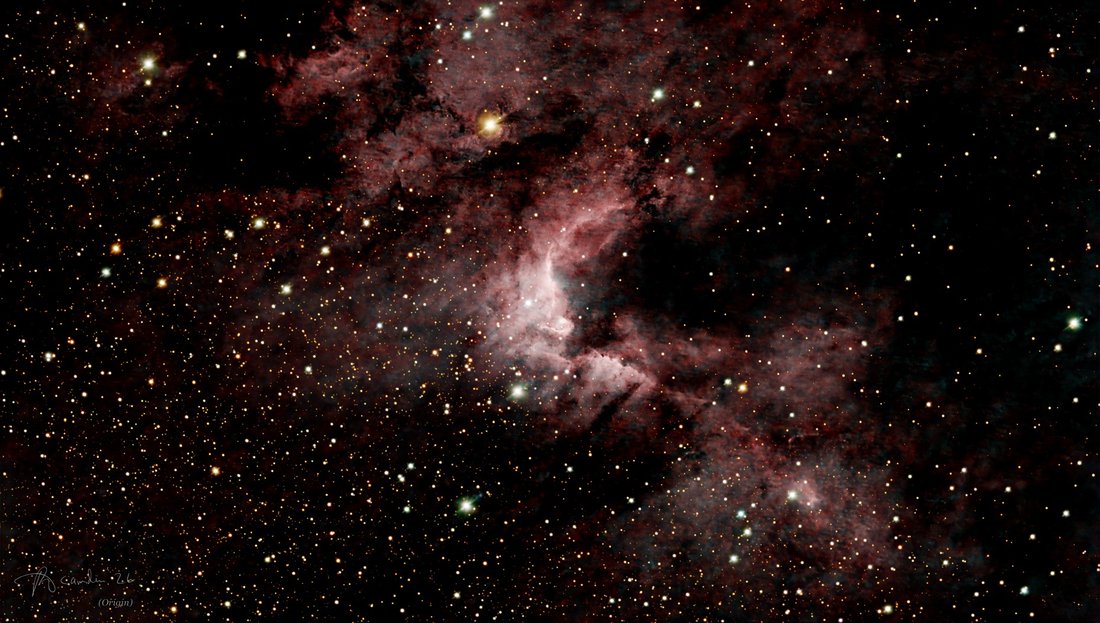
The Cave Nebula (Sh2-155), HOO with true-colour stars
How the final was made
The walking-noise story
The first stack came out streaked with “walking noise”: fine lines in the faint background. The imaging-side Claude measured the cause: the Origin’s dither moves the frame only east–west, and the first two sessions had been calibrated with a 15 s dark from June shot at 34.4 °C against 28 °C lights — 37 % too strong, turning every warm pixel into a hole that the one-way dither then dragged into a line. Old darks at the “right” temperature made it worse still (the sensor’s warm pixels change over months). The fix was fresh darks: the Origin’s own darks recaptured the next evening at 27.1 °C, plus the 26 September set at 20.8 °C, each scaled to its session’s temperature (k = 1 + 0.029 × ΔT), and a per-session walking-noise filter. Drizzle and one-pass stacking were tested and did not help.
Stacking (Siril)
- Graded every sub (
origin_cull.py): 42 culled — 5 streaked, 28 thin (haze), 2 comet-shaped, 7 end-of-night slew. Culls kept inraw/_culled_kept. - Each session calibrated on its own with the freshest matching dark, scaled to temperature, and a bad-pixel map.
- Split before debayer: red pixels → Hα, green + blue → OIII (half-size, 2.46″/px). The same subs split again into R, G, G, B for true-colour stars.
- Per-session walking-noise filter, sessions merged with star registration on one grid, row/column banding removed, cropped to full coverage (1859 × 1054). RGB star channels balanced on green.
PixInsight (Pete)
Origin HOO template: ChannelCombination, ImageSolver, SPFC, MGC (MARS), SPCC narrowband, BlurX, MLDenoise, OIII lift, GHS, black point, BlurX, StarXTerminator, HDRMT. The template’s three curves crushed the Cave’s faint nebula, so they were replaced with one faint-nebula lift curve (K 0.20 → 0.30), then a black point to sink the speckle in the darkest areas. Stars: balanced RGB stack, GHS, StarX, BlurX stars, ColorSaturation, MMT small-star trim, HT black point; screened back onto the starless. A deeper, more speckled version is kept in finals/versions.
Result
1857 × 1052, signed bottom-left with (Origin). AstroBin gets the true final (p99 147); web/FB/HC&M get a lifted copy (p99 181).
The image → The Cave Nebula — full size, with the story of the object