← Home

The Cave Nebula

Sh2-155 (Caldwell 9), in Cepheus  ·  7.3 hours in one night, September–October 2026

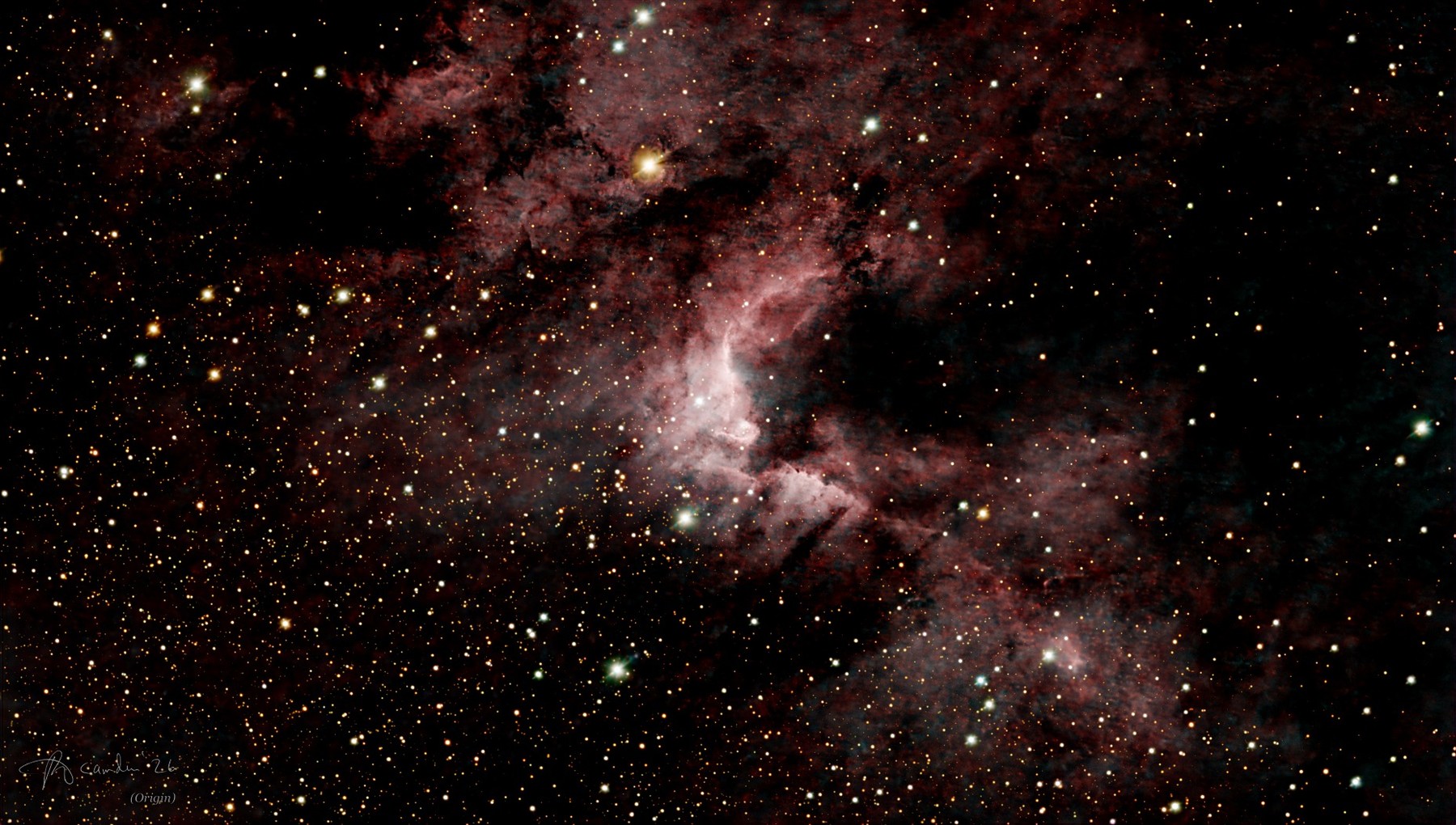
The Cave Nebula, Sh2-155 — a bright white and pink rim of glowing gas beside a dark lane of dust, in a field laced with faint red hydrogen and orange, white and blue stars

The Cave Nebula (Sh2-155, Caldwell 9), HOO with true-colour stars  ·  ©2026 Peter F. Wingard  ·  @see_theShow

The mouth of the cave

The Cave Nebula, Sh2-155 (Caldwell 9) in Cepheus, about 2,400 light-years away. It is the glowing edge of the Cepheus B molecular cloud: hot young stars of the Cepheus OB3 association are lighting the gas and eating into the cloud, and the dark dust lane along the bright rim is what gives it the look of a cave mouth. Around it, the whole field is laced with faint red hydrogen and dark dust, the part that takes all night to show.

This one was a learning night for the Celestron Origin: the first pass came out streaked with walking noise, traced to a dark frame from June shot 6 degrees too warm. Re-calibrated with fresh darks taken at the night’s own temperature, and the stars come from a separate true-colour stack so they keep their real colours.

Acquisition

Telescope
Celestron Origin — RASA 6″ f/2.2, 335 mm
Camera
Origin678C one-shot colour (IMX678) — ISO 1000, uncooled
Filter
Antlia Triband RGB Ultra — processed as HOO, stars from a separate true-colour stack
Framing
2.46″/pixel
Integration
1,751 × 15s = 7.3 hours, nine Origin sessions in one night — 42 subs culled
Dates
September 30 – October 1, 2026
Location
My backyard site at The Star Farm in Camden, South Carolina — Bortle 4
Processing
Stacked in Siril, processed in PixInsight

How it was made

The capture blog →See the legacy gallery →