← The Wizard Nebula — the image
Processing log · September 2026
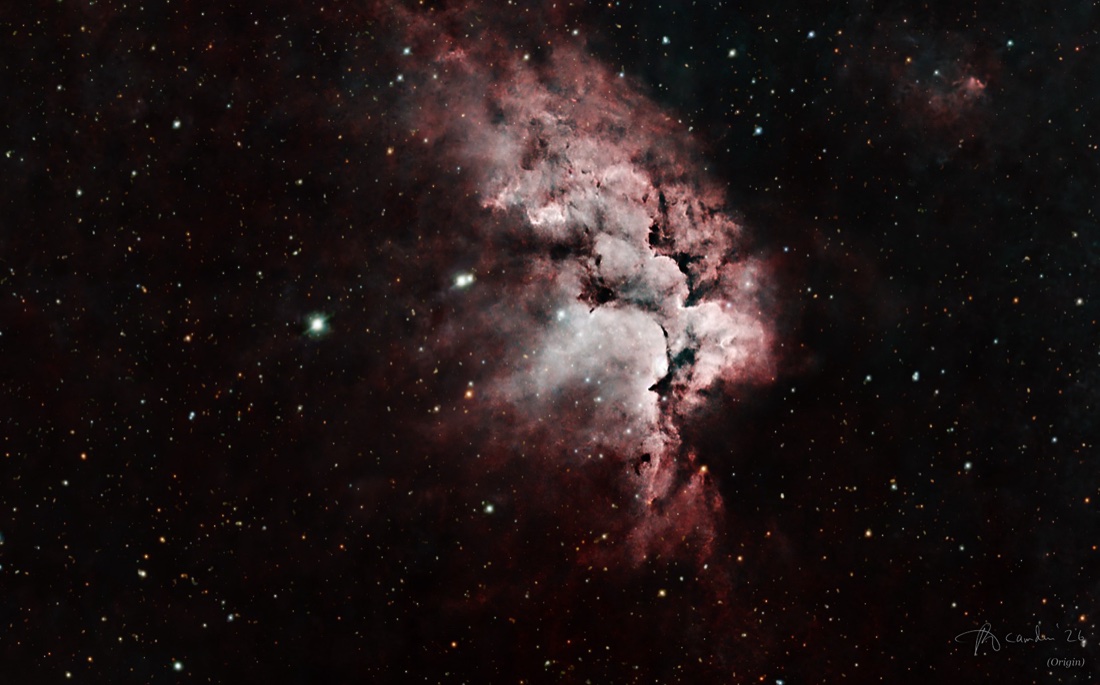
The Wizard Nebula (NGC 7380), HOO with true-colour stars
How the final was made
The night: a wrapped power cable
The Origin runs one-hour sessions so it re-centres, and between sessions it swings back toward the pole and out again. On this target that swing wound the power cable round the mount, and three sessions near the end were dragged off target. Every sub was graded (tools/origin_sub_qc.py): star shape, star count against the whole night’s median (two sessions were bad from start to finish, so a per-session median would have hidden them) and the pointing in each header. 49 culled — 34 of them more than 10′ off target, and the rest with no stars, streaked, or thin. The culls are kept, not deleted.
The fix for next time turned out to be in Celestron’s own manual: plug the power in before switching on, and the start position becomes a neutral point it never turns more than half a turn from.
Why HOO, not SHO
SII (672 nm) and Hα (656 nm) land in the same red band on the same red pixels, so they can’t be separated. HOO is the most this filter can honestly give.
Stacking in Siril
- Each session calibrated on its own with the matching 15 s dark (20.8 °C, against 21–24 °C lights) and a location-based bad-pixel map.
- Split before any debayer: red pixels → Hα, green + blue → OIII (
seqextract_HaOIII). Half-size frames, each pixel a 2×2 block — 4.0 µm effective, 2.46″/px. - The same calibrated subs split a second way for the stars: R, G, G, B as four separate planes on the same 2×2 grid, stacked as a true-colour star master. HOO stars can only be red, cyan or white; these keep their real colours.
- Six sessions merged with Siril star registration, one reference for all channels. Row and column banding from the Origin’s small dithers removed on the linear masters (9%/8% → 4%/3% of the noise). Cropped to the area every session covered, 1910 × 1061.
- A one-pass stack of all 777 subs was tried against the per-session merge: no sharper (4.51 vs 4.53 px) and noisier, so the merge stayed. The softness is in the data, not the stacking.
PixInsight — linear
ChannelCombination R = Hα, G = B = OIII; ImageSolver at 4 µm / 335 mm; SPFC narrowband; MultiscaleGradientCorrection with the MARS survey (it works for HOO — MARS has no SII, so SHO couldn’t use it); SPCC narrowband 656.3 / 500.7 / 500.7 nm at 25 nm; BlurXTerminator correct-only then stars 0.50; MLDenoise 0.90; and an OIII lift while linear, ($T-med($T))*1.3+med($T) on green and blue — the med() form lifts the nebula without tinting the sky.
PixInsight — non-linear
GHS stretch (factor 6.27, local intensity 0.05), black point 0.058; BlurX non-stellar 0.80; StarXTerminator to split the stars off; HDRMultiscaleTransform (6 layers) on the starless nebula; three curves; a second BlurX non-stellar pass at 0.80.
The stars
From the true-colour stack: StarXTerminator, BlurX on the stars (0.50), a PixelMath stretch ((3^5.04)*$T)/((3^5.04-1)*$T+1), ColorSaturation, and MultiscaleMedianTransform with layers 1–2 off to trim the swarm of small stars the Origin’s wide field produces. A HistogramTransformation black point then removed faint coloured “worms” — noise that StarX had carved into squiggles. Screened back onto the starless image: ~(~starless*~stars). Cropped to 1655 × 1031.
Result
Highlights at 194 of 255, sky 12/7/7, 0.04 % clipped; true-colour stars (orange, white, blue) over an HOO nebula.
This chain is now the template for every Origin image.
The image → The Wizard Nebula — full size, with the story of the object