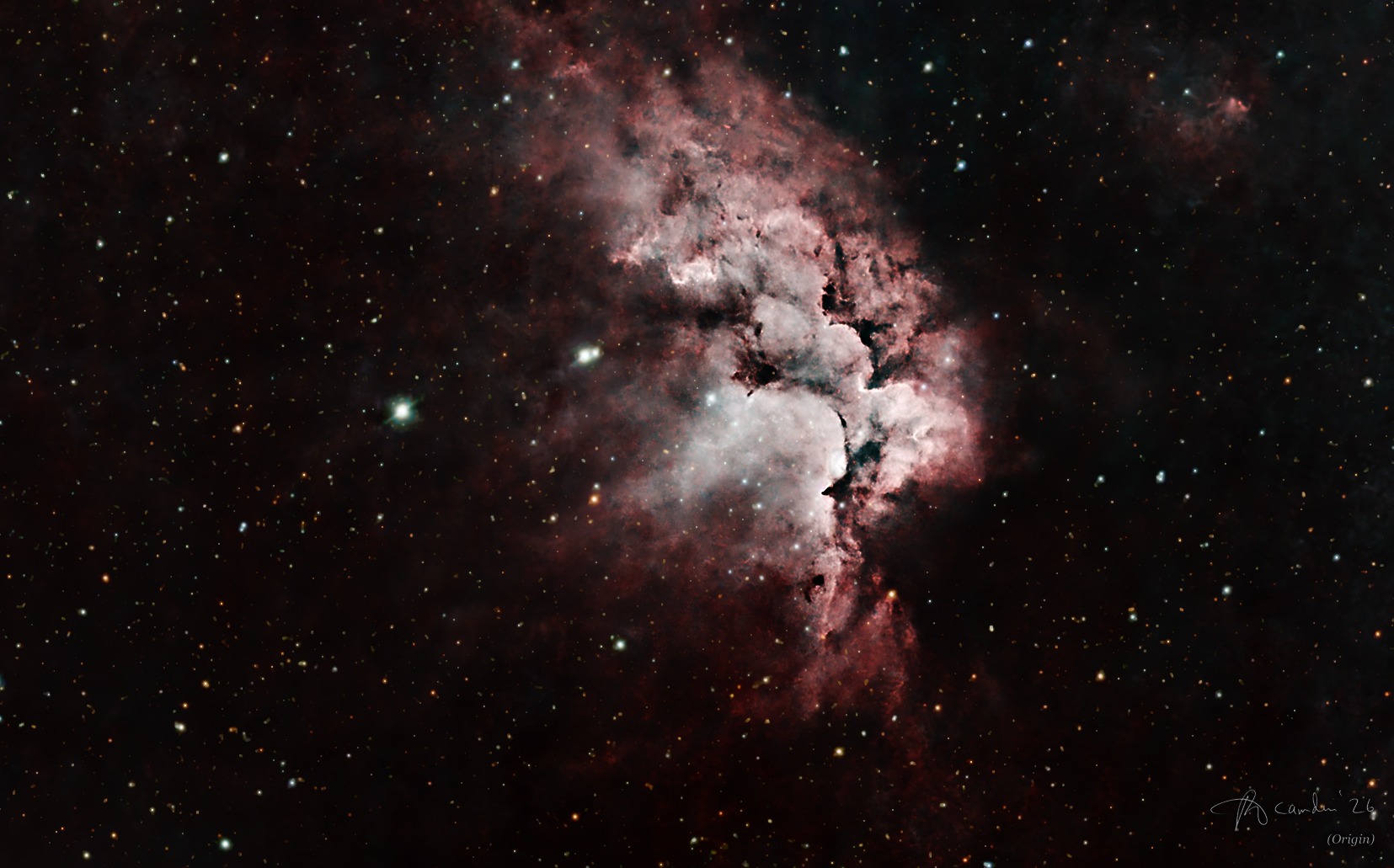
The Wizard Nebula, NGC 7380 in Cepheus, about 7,200 light-years away in the Perseus arm of the Milky Way. Caroline Herschel found the star cluster at its heart in 1787, one of the first women to discover deep-sky objects. The cluster is only about 5 million years old, and its hottest stars are the ones lighting the whole cloud and carving it into the shape that gives it the name: a robed figure leaning over, with the dark pillars and globules of dust being eaten away by the light. The glowing gas is about 110 light-years across.
This one comes from the Celestron Origin through an Antlia Triband filter, split into hydrogen and oxygen (HOO). The stars are the new part: the same subs were also stacked as ordinary colour and those stars were put back in, so they show their real colours instead of the red-and-cyan HOO stars usually give you. The night also had a wrapped power cable drag the scope off target a few times; 49 frames were thrown out and 777 kept.