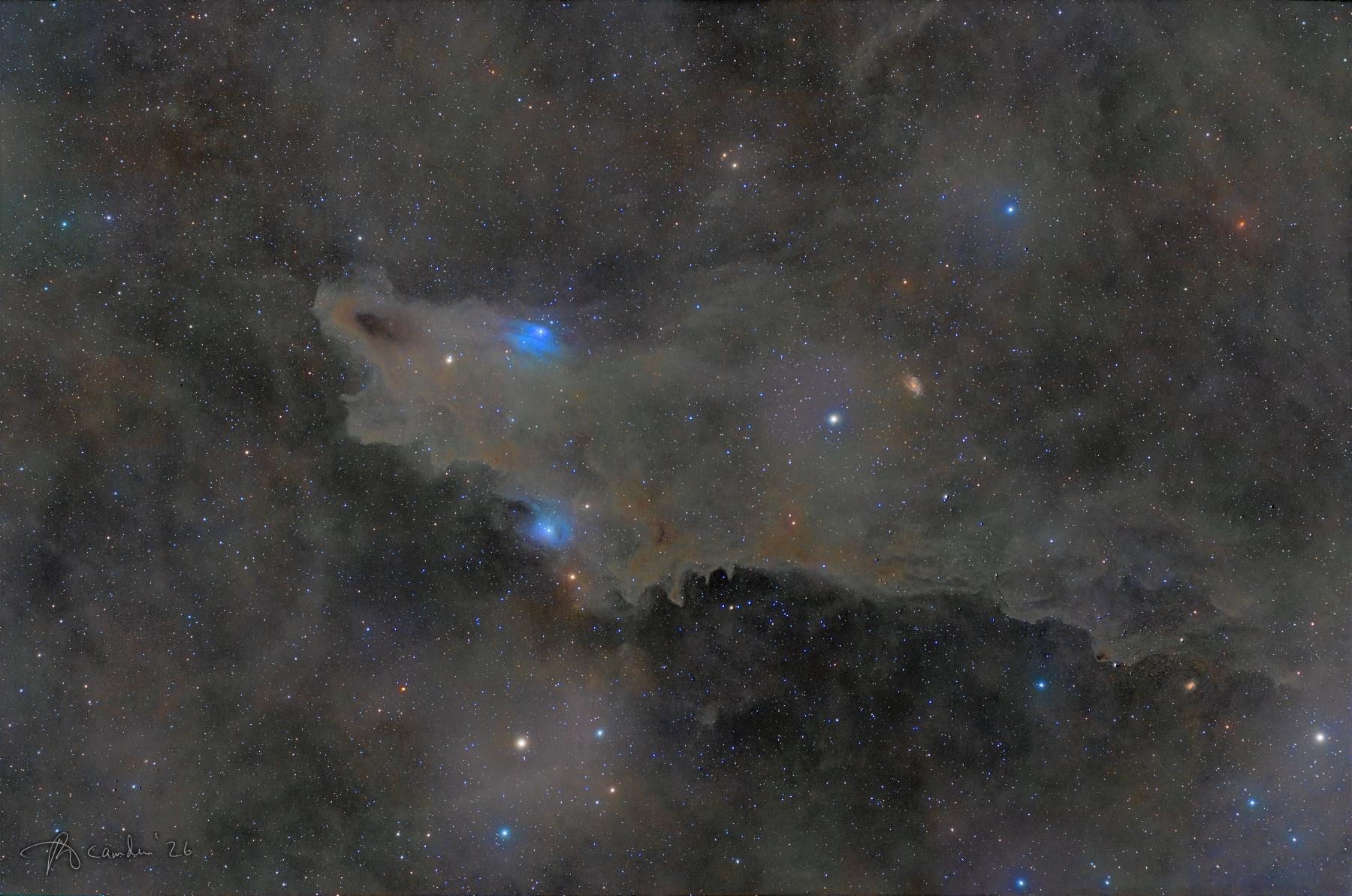
The Dark Shark doesn’t glow. Almost every nebula you’ve seen shines on its own: hydrogen lit up by a hot star, pink and bright. LDN 1235 does none of that. It is a cold cloud of dust roughly 650 light-years away in Cepheus, part of a larger complex called the Cepheus Flare, and the only light on it is the faint combined glow of the Milky Way’s stars reflecting off it. The shark is the dark part. You’re seeing it because the dust around it is ever so slightly brighter than the dust that makes the body, and because it blots out the stars behind it. The two small blue patches are reflection nebulae, vdB 149 and vdB 150, where a nearby star happens to light the dust up properly. And look at the fin: that little spiral is UGC 11861, a barred spiral galaxy roughly 70 million light-years away. The shark is 650 light-years off. You are looking through a cloud in our own back yard at a whole other galaxy a hundred thousand times farther away.
That is also why hardly anyone new to this goes near it. There is no emission, so narrowband filters, the usual beginner’s weapon against light pollution, don’t help at all. It has to be shot in plain broadband light from a dark sky. In a single exposure there is nothing there, not a hint of a shark. It only shows up after hours of stacking, and even then it is barely brighter than the sky glow. Worse, the flaws every camera and sky produce, uneven brightness across the frame and faint dust shadows on the sensor, look exactly like faint dust in space. Get the calibration or the gradient removal a little wrong and you either erase the shark or invent one. This one took 15.4 hours over four nights, and most of the processing time went into telling real dust from fake.