← Home

M15, the Great Pegasus Cluster

NGC 7078, in Pegasus  ·  LRGB with an HDR core — about 3.3 hours over three nights, October 2026

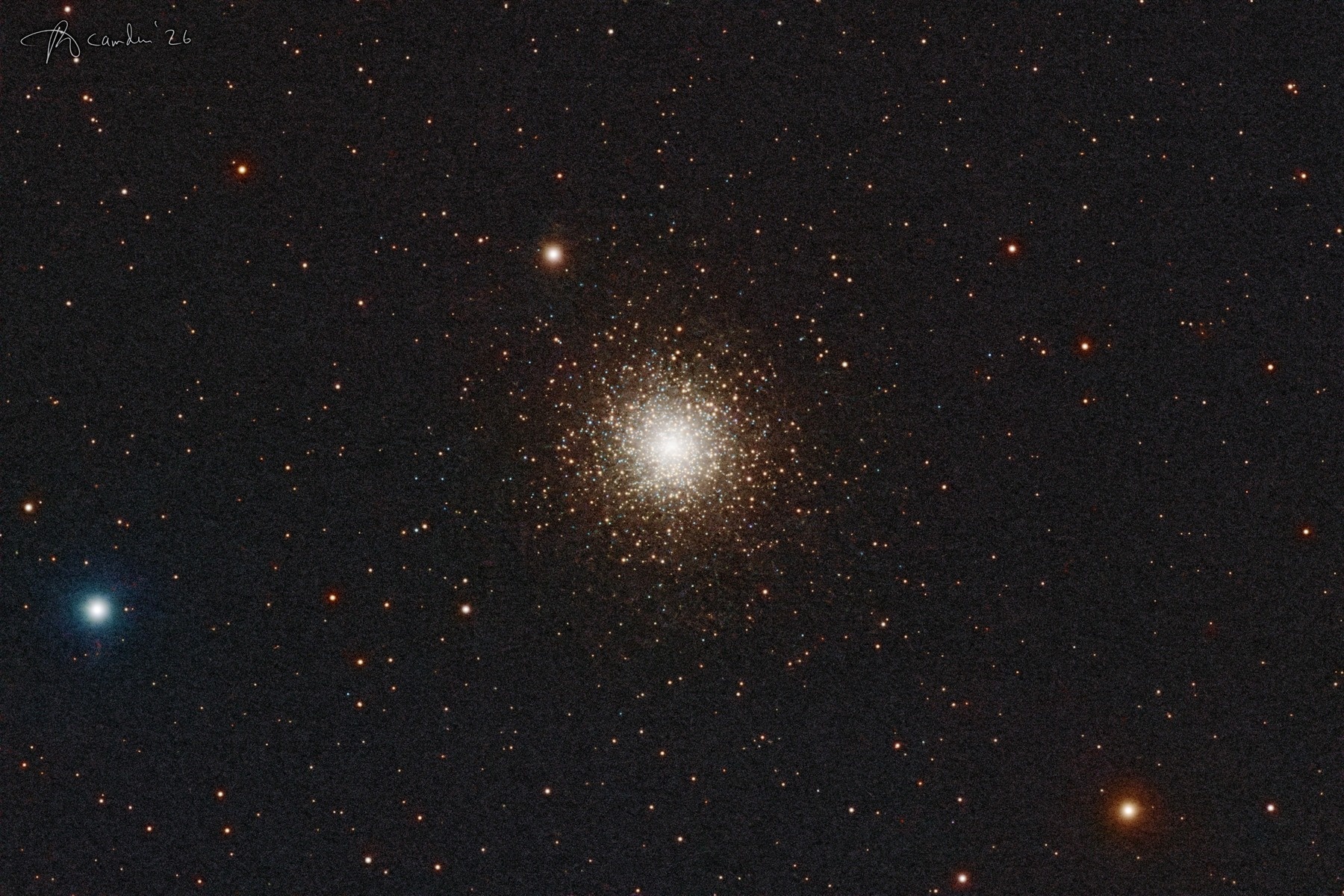
M15, the Great Pegasus Cluster — a dense ball of thousands of stars, white at the centre and gold and blue toward the edges, in a field of orange and white stars

M15 (NGC 7078), the Great Pegasus Cluster  ·  LRGB with an HDR core  ·  ©2026 Peter F. Wingard  ·  @see_theShow

A hundred thousand stars, twelve billion years old

M15, the Great Pegasus Cluster (NGC 7078). More than 100,000 stars packed into a ball about 175 light-years across, about 35,000 light-years away, and about 12 billion years old, one of the oldest clusters in our galaxy. It is one of the most tightly packed globular clusters in the Milky Way: its core has collapsed, with stars crowding ever tighter toward the centre. Hidden in that crowd is Pease 1, a tiny planetary nebula found in 1928, the first ever discovered inside a globular cluster.

The core here is not burnt out to a white blob: 1-second exposures were blended into the bright centre (HDR) so individual stars show right into the middle. The star colours are real, from separate red, green and blue exposures: the old red giants glow orange and the hot horizontal-branch stars blue. No star removal, no SCNR, no hue curves.

Acquisition

Telescope
Askar 80 with flattener — 495 mm, f/6.2
Camera
ZWO ASI2600MM Pro — gain 100, offset 50, −10°C
Filters
Antlia V-Pro L / R / G / B
Framing
0.98″/pixel (drizzle 1.6×), about 39′ × 26′, cropped around the cluster
Integration
L 100 × 60s, R 30 × 60s, G 30 × 60s, B 35 × 60s, plus 40 × 1s per filter for the core = about 3.3 hours — every sub reviewed by hand; 65 rejected
Dates
October 11–13, 2026 (three nights)
Location
My backyard site at The Star Farm in Camden, South Carolina — Bortle 4
Processing
Stacked in Siril, processed in PixInsight

The capture blog →See the legacy gallery →