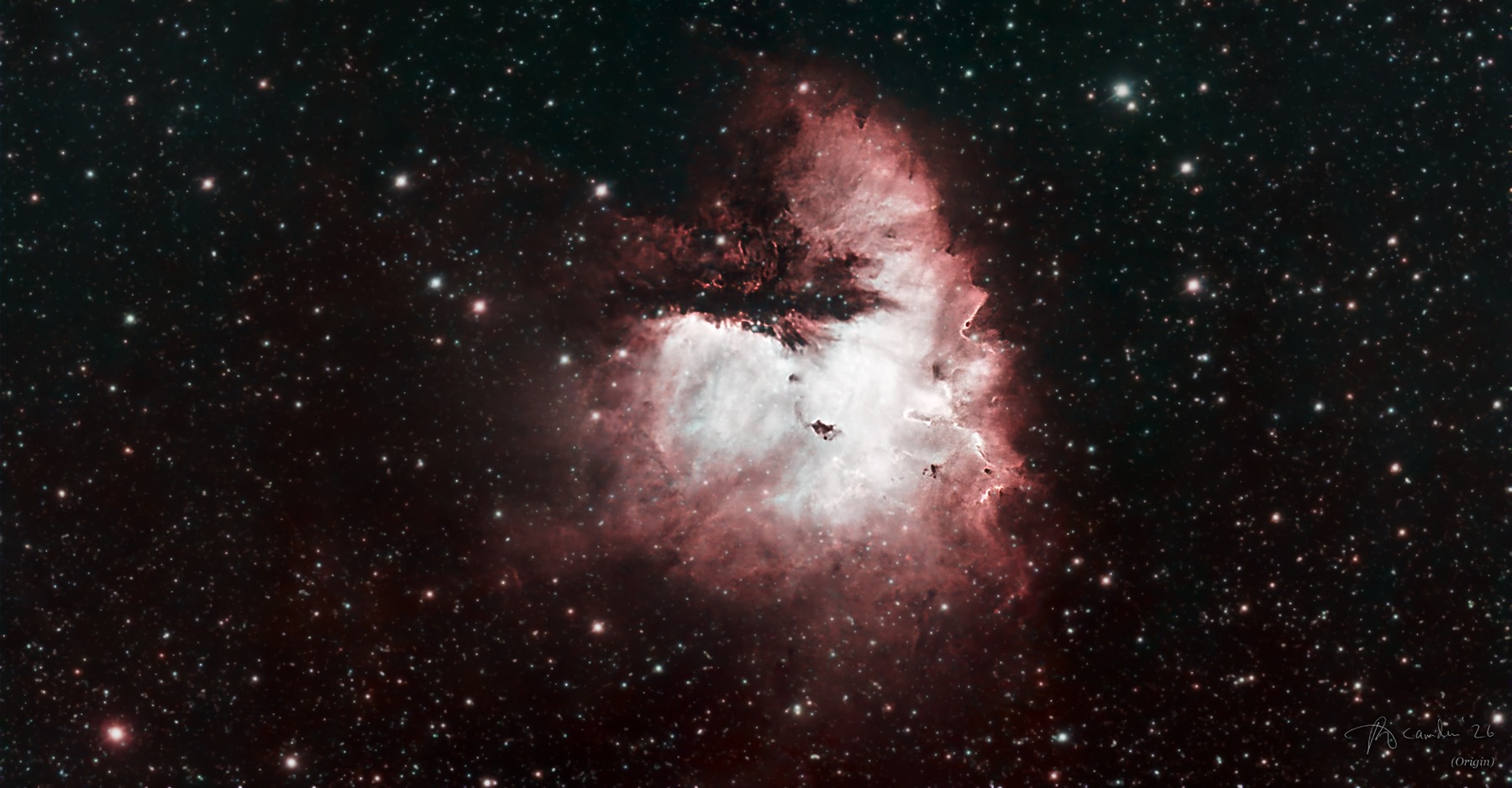
The Pacman Nebula, NGC 281 in Cassiopeia, about 9,500 light-years away in the Perseus arm of the Milky Way. E. E. Barnard found it in August 1883, almost a century before the video game gave it its name. The glow is hydrogen and oxygen lit up by HD 5005, a tight group of hot young stars whose brightest member is an O-type star tens of thousands of degrees hot, sitting at the heart of the open cluster IC 1590. The dark lane that makes Pacman’s mouth is a cold dust cloud in front of the glow, and the small dark blobs floating in the bright core are Bok globules: dense knots of gas and dust that are collapsing under their own gravity and may be forming new stars right now.
This one was shot with the Celestron Origin, a one-shot colour camera, through an Antlia Triband filter and processed as HOO: the red pixels became the hydrogen channel and the green and blue pixels became the oxygen channel. That meant pulling the colour camera apart into two narrowband-style channels, stacking six sessions separately with their own calibration, and removing the fixed-pattern banding a barely-dithered Origin leaves behind.